How to Control Snare Drum Ring in the Mix
Snare drums are one of the oldest instruments on the planet, simple in nature, but complex in tonality. They have two membranes stretched across wood, metal, or acrylic, with wires suspended on the resonant head to sympathetically buzz. The design has been around since the 14th century, and the snare drum is still the second most important element of every modern music mix, behind the lead vocal.
Acoustically, they are inherently difficult to control. There is no standard tuning, and we are just now using technology like Tune-Bot and Drum Dial to consistently tune drums to given frequencies, but it’s still not easy.
Drums naturally go “Boing!” Sometimes that ringing sound is wanted, in tune with the song, and cool. Oftentimes, the ring is annoying, takes up valuable sonic real estate in a mix, and needs to be tamed.
The simplest way to control snare drum ring is to do it at the source, on the drumhead. There are a plethora of tools, including various controlling drumheads from Remo, Evans, etc. Moon-Gels are a sticky solution; Roots-EQ rings are a personal favorite. Duct tape is also a very cheap and very effective solution. But what do you do when you have a mix that already has too much snare drum ring?
First, let’s define the components that make up snare drum ring: there is the time-based component and the frequency-based component.
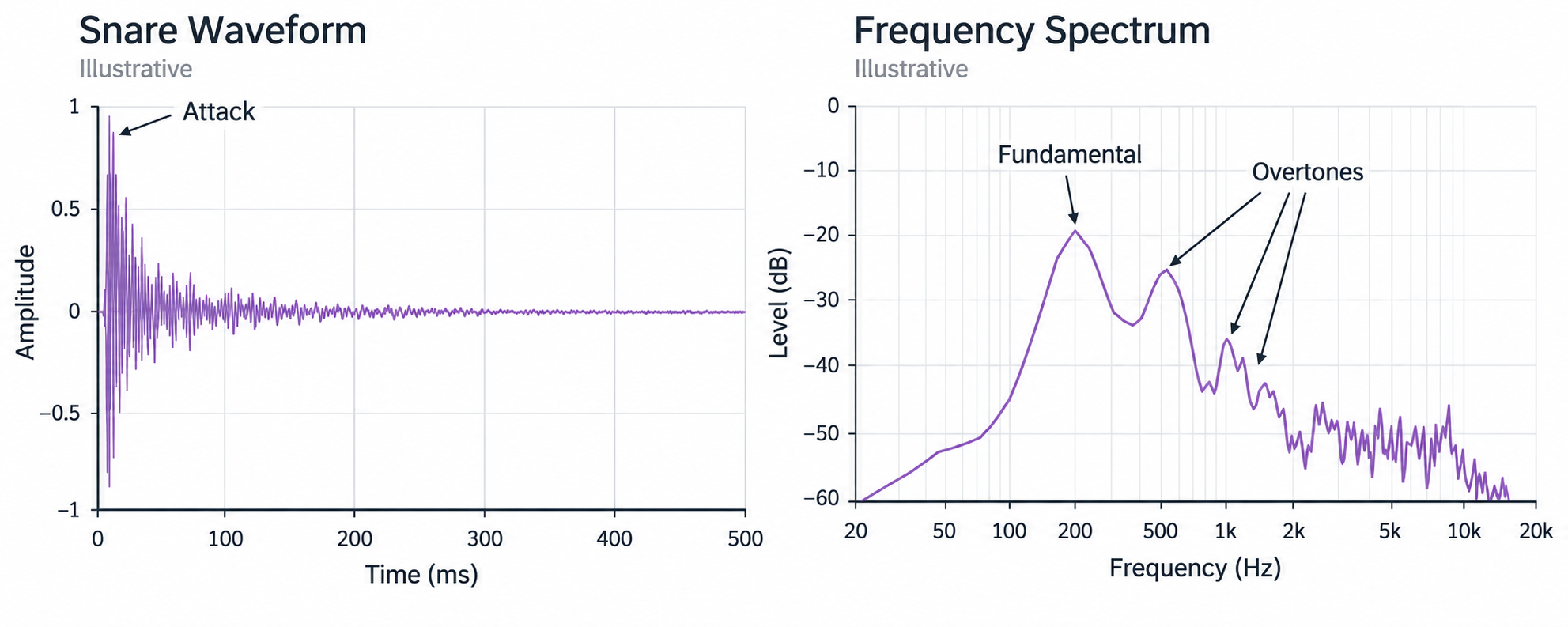
Snare Drum Waveform & FFT
The first few milliseconds of the drum hit, the “attack,” generally have the sound that the drummer is looking for: the right tone, the right snare crack. The ring happens after the first few milliseconds as the drum resonates. This is what we want to control.
There are a few post-processing mixing tools that can help with the time element of snare drum ring. Gates are helpful: they open up for the drum and close after an amount of time, so if there is a long tail on the drum, the gate “shuts” and cuts out or decreases the sound. This is helpful, especially in a live situation, but can be a blunt instrument that may take away too much character from the drum.
Additionally, a transient shaper like a Transient Designer can help increase the attack of the drum to make it cut through the mix better, but it doesn’t directly address the subsequent ringing overtones, although it can help shape resonance. Generally, compression, one of many mixing engineers’ favorite tools for drums, inherently increases the resonance of the drum, making the unwanted ring worse.
The frequency element gets to the heart of where ringing overtones are happening in the drum. Drums, like all instruments, have a fundamental tone, then a series of overtones that develop above that fundamental frequency. For example, if a snare drum has a fundamental frequency of 150 Hz, it may have strong overtones at 300Hz, 600 Hz, 1,200 Hz, etc. Some of the annoying ringing frequencies generally happen in the first few octaves above the fundamental frequency.
Traditionally, this is handled by standard EQ. There are a number of options: simply cutting low-mid to midrange frequencies with any mixer would help. A more surgical approach would be a graphic EQ or parametric EQ with an FFT analyzer like Fab Filter or the standard Logic Channel EQ. The downside to EQing the resonant frequencies is that it also applies the EQ to the attack of the drum, which may need some of those overtone frequencies to fully represent the drum hit. There are also some fantastic resonance suppressor plugins on the market like Oeksound Soothe, that do this process automatically but they can be expensive, high-latency and CPU intensive.
HOw RC SNARE Works
RC RING is an audio plugin for your DAW that reduces the ringing overtones of a drum without impacting the initial tone of the attack, and it does all of this automatically, without the need to understand fundamentals and overtones or read complex graphs with just 6 samples of latency and low CPU usage. Most importantly it’s free.
RC RING measures each snare hit and lets the first few milliseconds of the hit through without impacting the sound at all, to preserve the attack and character of the drum. Then AUTO tech goes to work and identifies the fundamental and subsequent ringing overtone frequencies. It measures 12 drum hits, then locks onto the overtone frequencies.
Narrow filters are applied to the three most prominent overtones above the fundamental. The user can then increase or decrease those frequencies by ±12 dB, represented as −100 to +100, with 0 not impacting the sound at all.
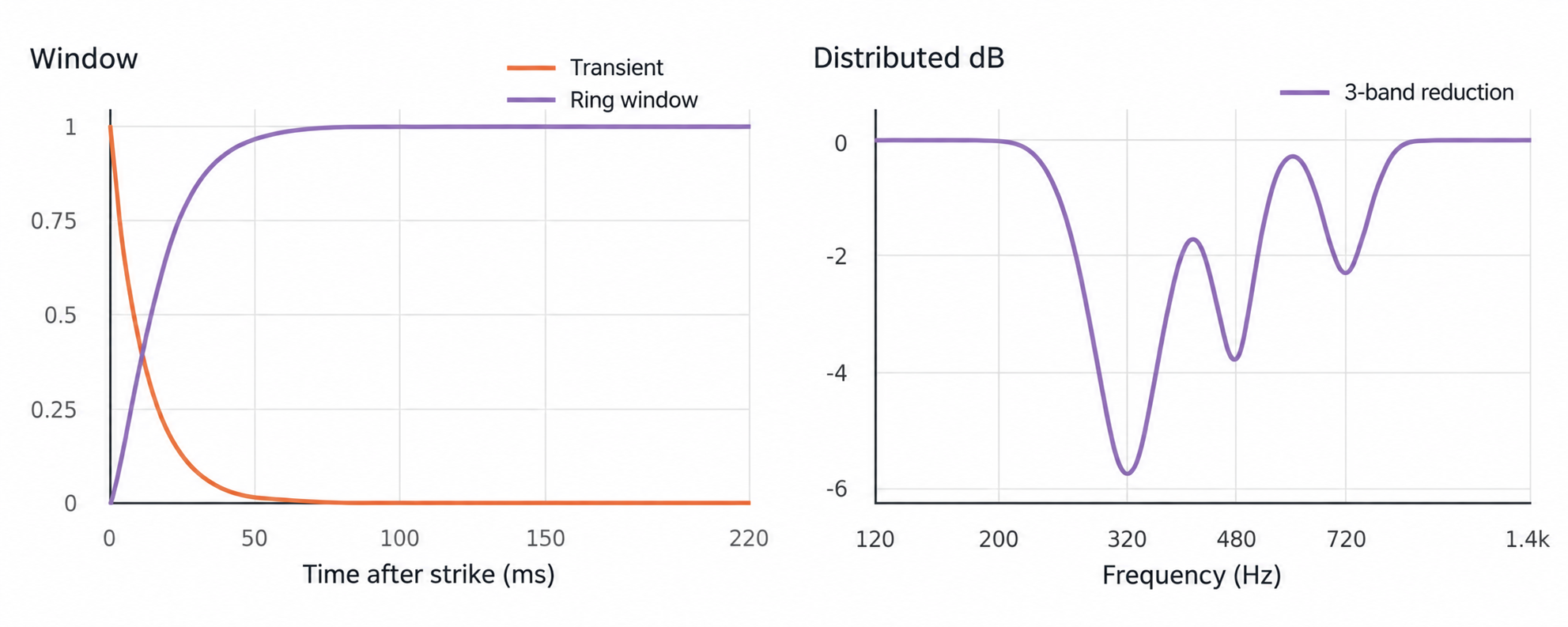
RC RING - Transient Window & AUTO tech overtone detection.
For genres like reggae, pop punk, hardcore, and ska, the ringing may be an essential part of the snare sound. RC RING allows the drummer, producer, or engineer to increase that ring if it is enhancing the song.
For most other commercial music, pop, rock, country, R&B, etc.ringing is generally getting in the way of other elements of the mix, and you would use the negative side of the dial to pull back on those overtones.
I sincerely hope you enjoy using this free tool to help improve your snare sound. RC RING is free and available for download here.
-RC